Damn Labs, a Pixelact Studio product
Damn Labs: free developer tools from Pixelact Studio
Damn Labs is Pixelact Studio's lab for free developer tools, including Commitscape, Hexlode, and EnvSift. If a “Built by Damn Labs” footer brought you here, the same studio designs and builds MVPs, web apps, internal tools, dashboards, and AI systems for funded startups. Need something like this built for your company?
What it is
Damn Labs at a glance
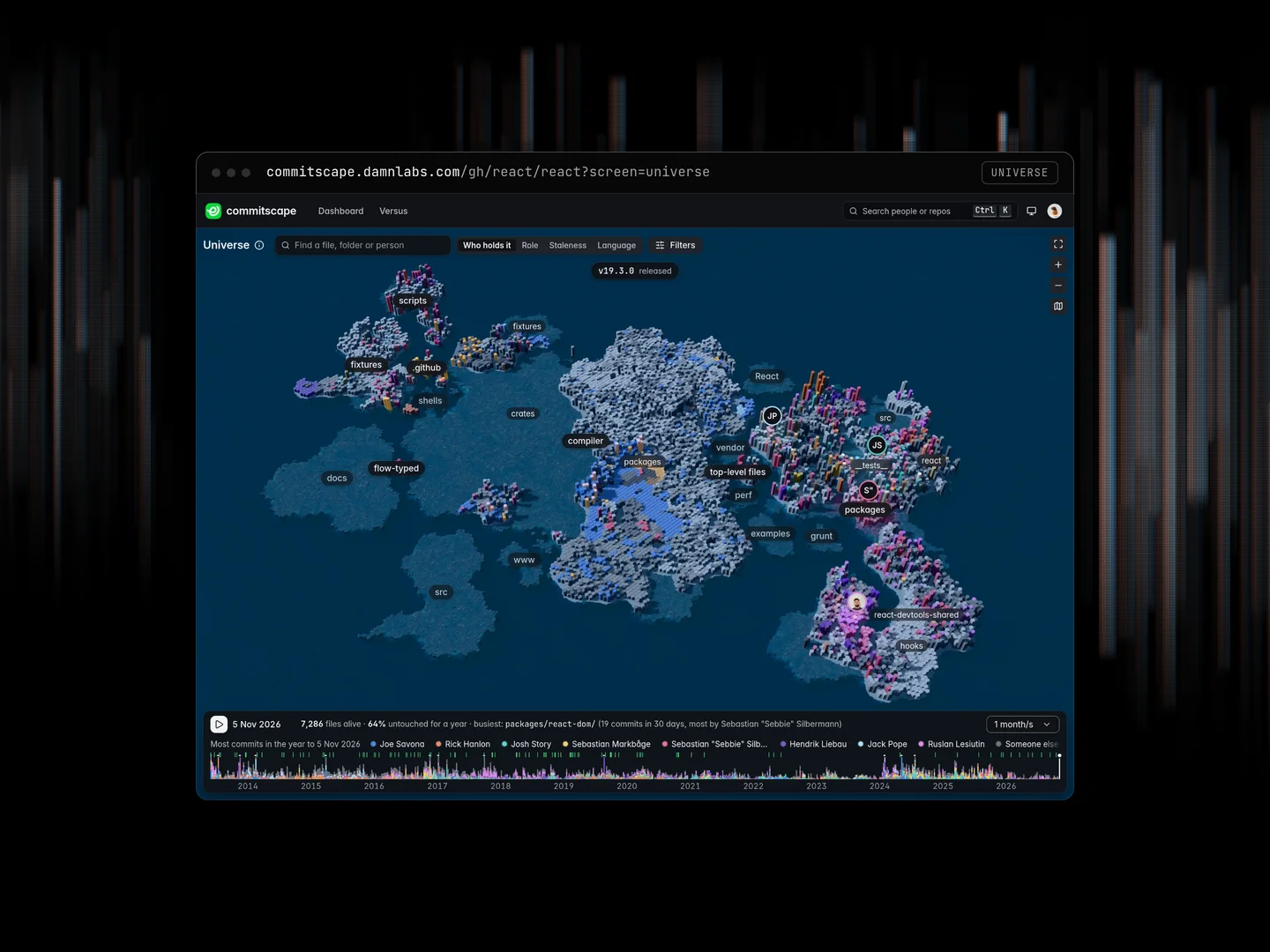
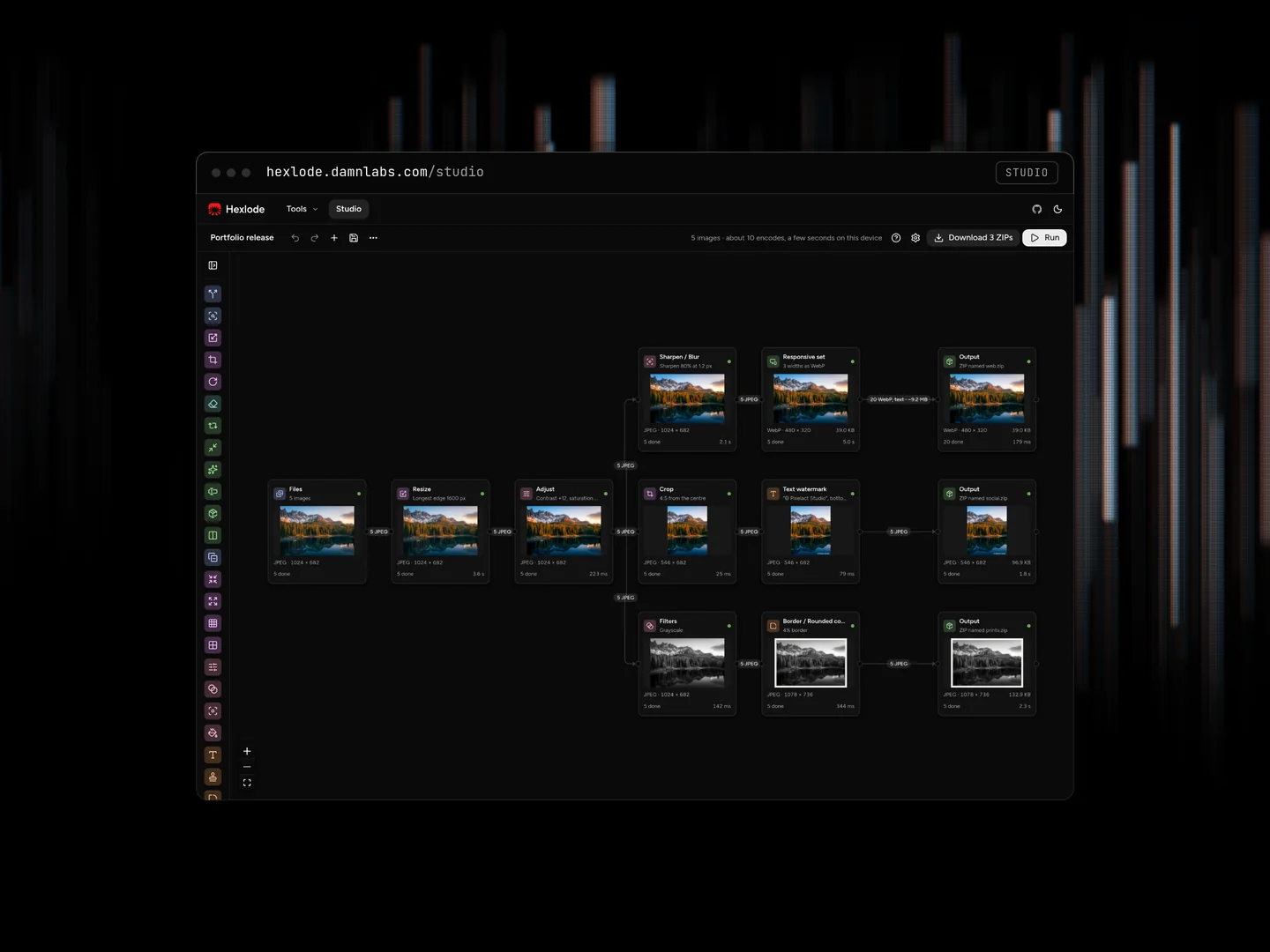
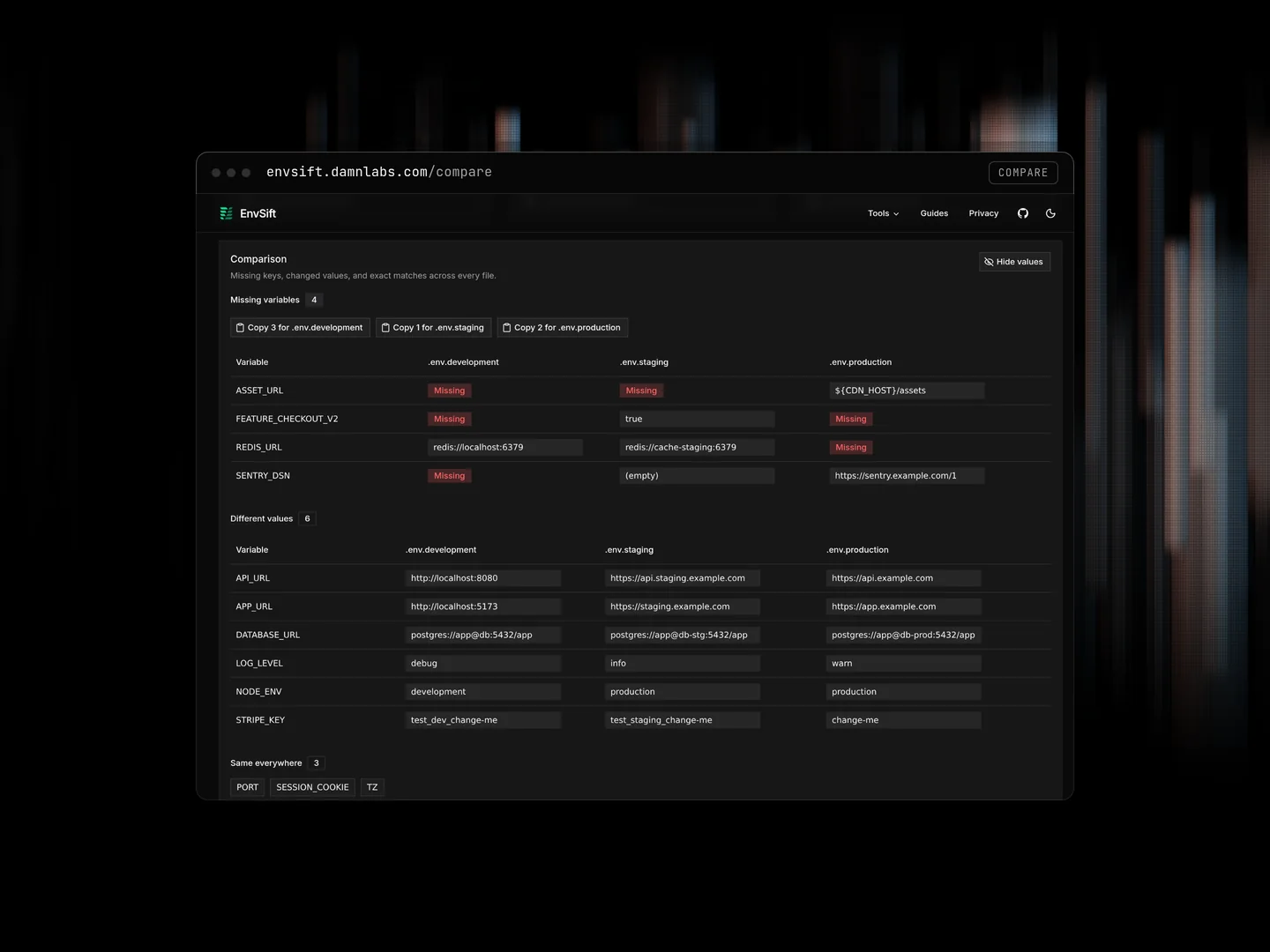
Damn Labs is Pixelact Studio's experimental software lab. It publishes free, open source developer tools: Commitscape shows what a developer built from a Git repository's history, Hexlode processes images in the browser, and EnvSift checks and converts .env files. Pixelact Studio builds each tool to the engineering standards it sets for client work and publishes the source on GitHub.
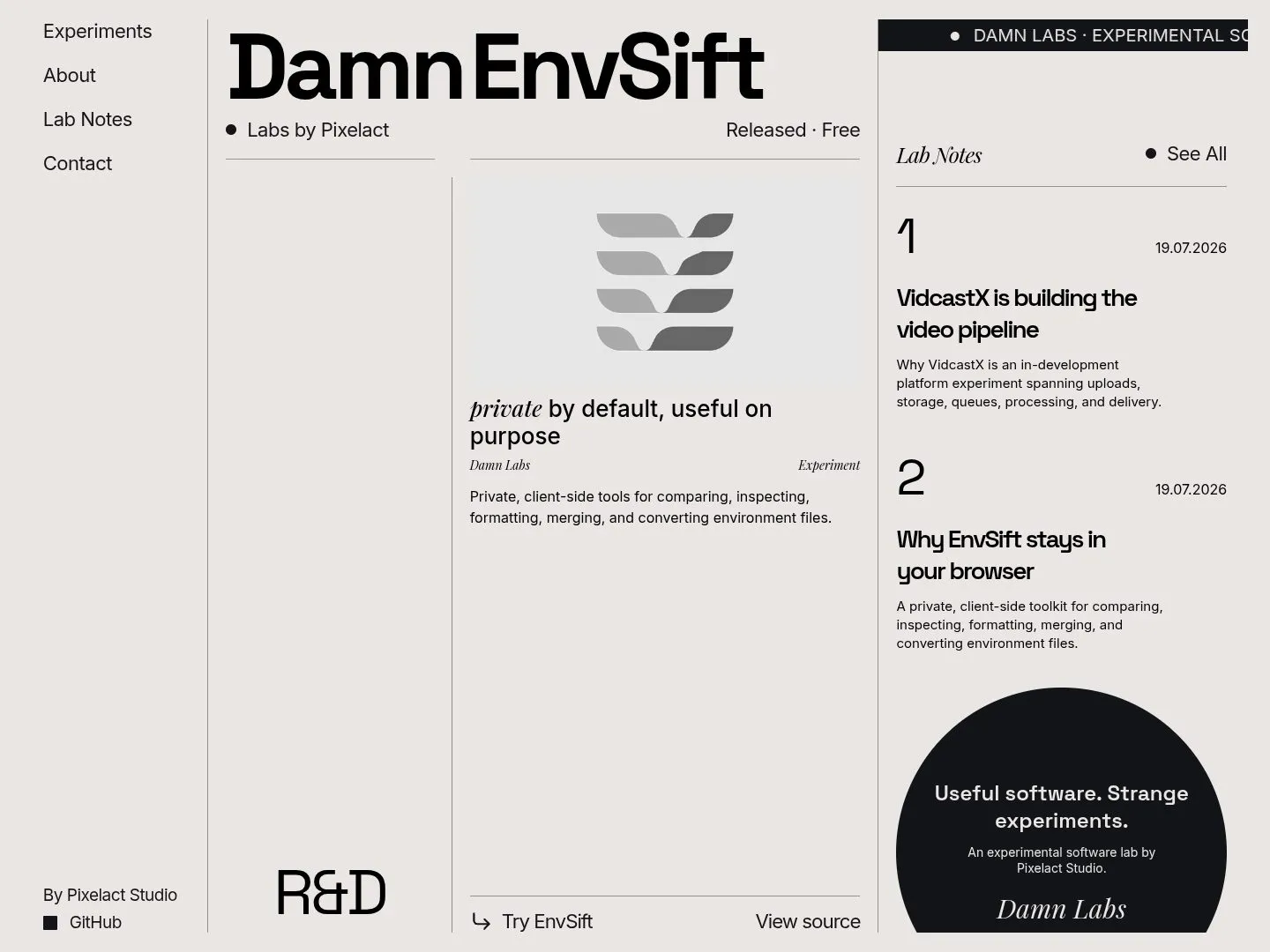
Tools
Free tools you can use today
Each tool is open source. Read what it does, how it's built, and the decisions behind it.
What is Damn Labs?
#Damn Labs is the experimental and R&D branch of Pixelact Studio. Its home is damnlabs.com, where each tool has its own subdomain. A tool earns a place when it makes a recurring job easier, answers a technical question in working code, or teaches us something that changes how we build.
Each tool is described at the stage it has reached: EnvSift and Hexlode are live, and Commitscape is live but in early development, with a command line and website that work end to end.
Why does Pixelact Studio run Damn Labs?
#Damn Labs lets us test ideas on our own time and gives buyers working code to inspect before hiring us. Client code stays private, so the lab is where anyone can read our code, tests, and decisions.
Commitscape records its architecture decisions as numbered ADRs, and its CI runs Rust, TypeScript, and end-to-end Chromium tests with accessibility checks. Hexlode runs CodeQL and a weekly test that pushes 500 images of 12 megapixels through one template while checking memory. Our engineering standards set the same practices for client projects.
Why are these free developer tools privacy-first?
#Because developers paste secrets, private images, and company code into tools like these. Each tool does the sensitive work on your device wherever it can.
| Tool | What it does | Where your data goes | License |
|---|---|---|---|
| Commitscape | Counts what a developer built from Git history: merged pull requests, reviews, and lines that still run | The CLI reads history locally and asks before uploading a report encrypted with AES-256-GCM, whose key only the link holds. The Commitscape website reads repositories you open on its servers | MIT or Apache-2.0 |
| Hexlode | Converts, compresses, resizes, crops, and strips metadata from images, alone or in batches | Images are processed on your device. Analytics events exclude image bytes, filenames, thumbnails, and metadata | Apache-2.0 |
| EnvSift | Compares, validates, merges, and converts .env files | Pasted values and local files are processed in the browser. Analytics events exclude keys, values, and filenames | Apache-2.0 |
To check this yourself, open the Network panel in your browser's developer tools while you use EnvSift or Hexlode.
What does the same engineering look like in client work?
#The same patterns fit products that handle files, secrets, or data customers would rather not hand over.
- Processing on the client. A product can convert, compress, or strip metadata from files in the browser with WebAssembly, as Hexlode does, so the original never reaches your servers. We build this into product development work.
- Encrypted sharing. A report can be encrypted before upload, with its key after the
#in the link, which browsers never send to servers. Commitscape's CLI works this way, so its servers store data they cannot read. - Background jobs. Commitscape's Builder takes jobs from a Postgres queue and uploads results to object storage, the same shape behind imports, exports, and scheduled syncs in internal tools and data systems.
- Configuration hygiene. EnvSift compares
.envfiles because a variable missing from one environment can break a deploy that worked locally. A software audit checks how your product stores secrets and whether any API keys are exposed.
Client work adds what a free tool does not have: a named lead, a written scope with milestones, and code, accounts, and a repository your company owns.
How do I start a project with Pixelact Studio?
#Fill in the short form on Start a project. We reply to every project inquiry within one business day.
- 01Describe the projectSay what you want built or fixed, pick a budget range, and tell us how you heard about us.
- 02Book a discovery callWe reply with times for the call. The 45-minute call has no slides: we ask what prompted this now and what a good outcome looks like, then say whether we fit.
- 03Review the proposal liveWithin 48 hours of the call, we walk you through scope, exclusions, milestones, and two or three options live, then confirm everything in writing.
To test an idea first, a pilot sprint from $4,500 proves one thing at a fixed price, and a software audit from $2,500 reviews a product you already have.
FAQ
Questions about Damn Labs
Straight answers on cost, your data, licenses, and custom builds.
Yes. Commitscape, Hexlode, and EnvSift are free to use and open source. Hexlode and EnvSift use the Apache License 2.0, and Commitscape is available under MIT or Apache-2.0. You can read the source and run each tool locally. Hexlode and Commitscape also publish Docker images, and their repositories explain how to self-host them.
No. Damn Labs is Pixelact Studio's experimental and R&D branch. Pixelact Studio is the commercial side, with written scope and delivery responsibility for client software. Damn Labs holds self-directed tools and prototypes where the question comes before any brief. The same people build both, and every Damn Labs tool links back to Pixelact Studio in its footer.
Hexlode and EnvSift do not. They process your images and .env files in the browser and send only filtered analytics events to PostHog, never file contents, keys, or filenames. Commitscape's CLI uploads a report only after you say yes, encrypted so its servers cannot read it, and DO_NOT_TRACK=1 turns off its anonymous usage count. The Commitscape website reads the repositories you open there on its own servers.
Yes. A tool like EnvSift or Hexlode is usually an internal tool or a product feature, and we build both, priced by milestone after a discovery call. If you are not sure the idea works, a pilot sprint from $4,500 proves one thing first at a fixed price, such as one automated workflow or a technical proof that browser-side processing handles your files.
Open an issue on the tool's repository in the Pixelact Studio GitHub organization. Commitscape, Hexlode, and EnvSift are public repositories with issues turned on. Include the browser or platform, the steps that reproduce the problem, and what you expected. Damn Labs tools are free, so fixes ship on the lab's schedule rather than under a support agreement.
You do. Your company owns the code, accounts, and repository, and the final code and files transfer once the final invoice is paid. Handover is written so any engineer can pick the work up. Damn Labs tools stay ours and open source, and nothing from your project appears there or anywhere public without your permission.
Custom builds
Need a tool like this built for your team?
The engineers behind Damn Labs build internal tools, data systems, and product features for startups. Tell us what you need, or book a call to talk it through.
On the discovery call
- 01What prompted this now, and where things stand
- 02What a good outcome looks like
- 03Whether we're a fit, and what a next step could be
45 minutes. No slides, and no long questionnaire.