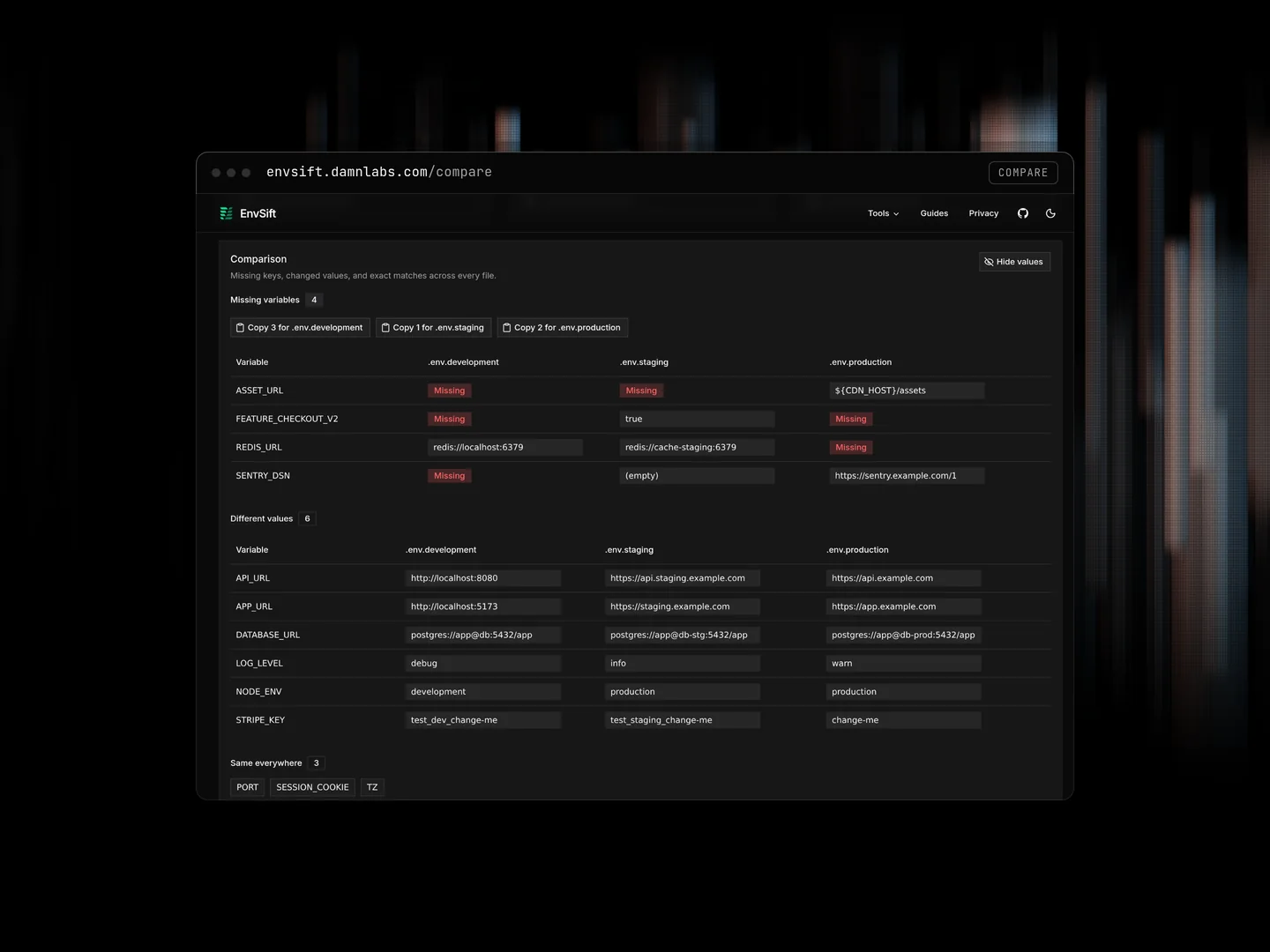
EnvSift: open source .env tools that run in your browser
EnvSift compares, validates, merges, formats, redacts, and converts .env files inside the browser tab, with no application server to receive them. Pixelact Studio built it under its Damn Labs branch and released it under the Apache License 2.0.
An open source web app that compares, validates, merges, formats, and converts .env files in the browser, with no application server to receive them.
EnvSift at a glance
Type
Open source web app with six tools for working with .env files
Built by
Pixelact Studio, under its Damn Labs branch
License
Apache License 2.0
Status
Live at envsift.damnlabs.com. Latest release 0.2.0, July 2026
Platform
Any modern browser, served as prerendered static files from Cloudflare Pages. Runs locally with Node.js and pnpm
Stack summary
TypeScript, React 19, TanStack Start, Tailwind CSS, shadcn/ui on Base UI, Vitest, and cookieless PostHog analytics
Privacy model
Pasted text and local files are processed in the browser tab. Analytics events never include keys, values, or filenames
Decisions
The decisions behind EnvSift
The technical calls that shaped how it works: what we picked, and the trade-off that made it the right pick.
Decision 01
No application server
What we chose
EnvSift ships as prerendered static files, and every tool runs in client-side TypeScript inside the open tab.
Why
People paste live credentials into tools like this. With no server that receives content, there is no server copy of a credential to protect or delete, and anyone can confirm what leaves the page in the browser's network panel.
Decision 02
One parser behind the tools
What we chose
Compare, validate, format, merge, and convert all read input through one parseEnv function, and the six WebMCP tools offered to browser agents call those same functions.
Why
Two parsers would disagree on multi-line values or escaped quotes, and a fix in one would miss the other. With one parser, each edge case is fixed and tested once, and a single test runs a multi-line private key through the formatter, the converter, and the merger.
Decision 03
Analytics that fail closed
What we chose
Each custom analytics event has a typed list of allowed properties, a filter drops any event or property that is not listed, counts are bucketed, and PostHog runs in cookieless mode.
Why
A denylist leaks the first property nobody thought to block. An allowlist keeps a new field out of analytics until someone adds it on purpose, and tests check that no editor content reaches a captured event.
Decision 04
A configuration tool, not a secret vault
What we chose
The product brief plans to grow EnvSift toward an environment contract: variable names, where each one is expected, and findings, with values left on the developer's machine or with the deployment provider.
Why
A hosted vault, secret rotation, and automatic production sync would turn EnvSift into security-critical infrastructure. The brief defers them, and the planned server would store names, metadata, and scan history, never values.
EnvSift is an open source web app, built by Pixelact Studio under its Damn Labs branch, that compares, validates, merges, formats, redacts, and converts .env files. Pasted text and local files are processed in the browser tab, so no application server receives them. It is free at envsift.damnlabs.com and licensed under the Apache License 2.0.
EnvSift gives developers six tools for the jobs that come up as soon as an app runs in more than one environment. Problems are reported by line number, and the formatter, merger, and converter refuse input with syntax errors rather than guess.
Tool
What it does
Detail that matters
ENV Compare
Finds missing and changed variables across two or more files
Values stay hidden until you reveal them, and it can copy the entries each file is missing
.env.example Generator
Removes values to make a template teammates can copy
Comments stay as written, so read them before committing. Invalid or duplicate lines become comments saying they were left out
ENV Validator
Checks syntax and common mistakes
Flags invalid lines, duplicate keys, empty values, ${NAME} references to missing variables, and stray whitespace
Merge & Clean
Merges two files into one sorted file
One file wins every conflict, or you choose per key, and no output appears until all are resolved
ENV Formatter
Normalizes quotes and ordering and drops duplicate assignments
It refuses to strip quotes from a value that contains spaces or special characters
Format Converter
Converts ENV or flat JSON to ENV, JSON, shell exports, or Docker Compose
Compose output can carry the values or ${NAME} references
The six EnvSift tools
It is for the developer joining a project who needs a working .env, the engineer chasing a setting that differs between staging and production, and the team moving configuration into Docker Compose. There is no account and nothing to install.
EnvSift catches configuration drift, the gaps between .env files that surface as runtime errors after a deploy. A variable added on one laptop never reaches .env.example, or staging carries a key that production lacks.
Comparing files by eye misses things, and pasting them into an online diff tool can send live credentials to a server nobody on the team controls. EnvSift keeps the work in the tab, and anyone can check that: the parser, the analytics filter, and the tests are public, and the browser's network panel shows every request the page makes.
EnvSift is a static site. TanStack Start prerenders its pages at build time, and all processing happens in client-side TypeScript in the open tab.
01ReadYou paste text, pick a file, or drop one. The browser's File API reads the file inside the tab, and the filename stays out of analytics.
02ParseOne function, parseEnv, turns the text into entries with line numbers and a list of issues marked as errors or warnings.
03TransformCompare, validate, merge, format, and convert all work from that parsed result, so each of them reads a file the same way.
04OutputCopy uses the Clipboard API, and downloads are built as local blobs. Editor contents are never saved, so closing the tab clears them.
The same functions are open to AI agents. In browsers that support WebMCP, a draft web API that lets a page offer tools to AI agents in the browser, EnvSift registers six tools that mirror the visible ones. Each is marked read-only and rejects any input string over 100,000 characters. The validator tool returns line numbers, key names, and counts, never values.
The tools still run in the tab, but anything a person hands to a browser agent also falls under that agent provider's privacy terms. The EnvSift privacy page says so plainly.
Three parts of EnvSift took the most care: parsing the files developers actually write, converting values without changing them, and measuring use without collecting content.
There is no single .env standard. Real files hold PEM private keys across several lines, export prefixes, inline comments, and quotes escaped with backslashes. The parser keeps reading a quoted value until it finds a closing quote preceded by an even number of backslashes, so an escaped quote at the end of a line does not cut the value short.
A line that is not a portable KEY=value assignment, with a key of letters, digits, and underscores that does not start with a digit, becomes an error with a line number, never a silent guess.
Converting is where values quietly change. A JavaScript number cannot represent every integer above 9,007,199,254,740,991, the value of Number.MAX_SAFE_INTEGER, so a long numeric ID in JSON input can be rounded on the way through. JSON.parse has already rounded it by the time it returns, so the converter scans the raw JSON text and rejects those numbers with a request to quote them.
Docker Compose reads a dollar sign as the start of a variable, and Docker's interpolation reference says a literal one must be written as $$. The converter turns ${HOST_SECRET} inside a value into $${HOST_SECRET}, using a replacer function because replaceAll reads $$ in a replacement string as a single dollar sign. Shell exports wrap each value in single quotes, so $HOME inside a value stays literal, and they split the quoting around any single quote in the value.
Version 0.1.0 configured PostHog to keep its identifier in local storage. Work on 0.2.0 tried a consent banner first, then replaced it before release with PostHog's cookieless mode, which keeps no analytics identifier in cookies or browser storage.
A filter drops any event that is not on an allowlist and any custom event property that is not listed for that event. It also strips query strings and fragments from URLs and turns exact counts into buckets such as 11 to 50 variables. The README states the cost: weekly and monthly unique-user counts are not reliable.
What does EnvSift show about how Pixelact builds software?
EnvSift shows the practices we use for product development: automated checks on every change, tests for the privacy promises, scope decided in writing, and AI-drafted work merged only after review.
Every change passes the same gate. CI runs Vitest, the TypeScript compiler, ESLint, a Prettier check, and a full production build on every push and pull request, the checks our engineering standards require on every project. Cloudflare Pages deploys a preview of each pull request, and commit hooks lint staged files and enforce Conventional Commits.
Tests guard the promises, not only the features. They check that a generated .env.example drops the values it was given, that the WebMCP validator returns no values, that analytics never receive editor state, and that page metadata carries no invented review data such as star ratings.
Scope is decided in writing. The product brief defers a hosted secret vault, secret rotation, and automatic production sync. In the planned repository scanner, AI may only suggest changes for a person to accept, and repository changes arrive as visible pull requests.
AI speeds up the work, and review stays. Later features, such as the SEO guides and the WebMCP tools, were drafted by an AI coding agent on short-lived branches. Each pull request passed CI and an automated correctness check before a person merged it, as in our AI code review workflow.
The same engineers design and build products, internal tools, and AI systems for funded startups. Tell us what you need, or book a call to talk it through.